Arc Finance OS: Multi-Agent Finance Workspace
A leadership brief and a few business files go in. Four specialist agents review them in parallel, a CFO agent challenges the memos and signs off, and a structured report comes out with its assumptions and data limits on the page.
Personal Project · Live on Vercel
5
AI Finance Roles
Four specialists and an independent CFO, each with its own remit
4
Parallel Reviews
Specialist analyses run at once on the OpenAI Responses API
8
Deliverables
From management accounts to board packs, combined into one pack
3 of 4
Completion Gate
The minimum specialist memos, or the run fails safely with no report
Arc Finance OS is AI-assisted decision support, not an audit. It produces evidence-aware finance reports from the brief and files it is given, and it discloses where the evidence runs out. It is a production-oriented MVP with real model execution and explicit quality gates, not a system of record. Material decisions still belong with qualified finance professionals.
The Problem
One question, five disciplines
A single leadership question, “where do we actually stand, and what should we do,” usually spans accounting integrity, performance analysis, liquidity, forecasting, and executive communication at once. Answering it manually means pulling in several finance roles and coordinating their work into one view.
Ask a single general-purpose chatbot instead and you get a confident, unsourced narrative that blurs facts, assumptions, and estimates together, and invents the numbers it does not have. That is worse than no answer, because it looks finished.
So I built a small finance team instead of a single voice.
The Finance Team
Four specialists and a CFO
Each role has its own prompt, remit, and model call. The four specialists review in parallel, then the CFO challenges what they found and decides what the report says.
Elena Vasquez
Chief Financial Officer
Challenges the specialists, reconciles their conflicts, frames the decisions, and approves the final report. Nothing ships without this sign-off.
Marcus Chen
Financial Controller
Tests source reliability, reconciliations, cut-off, accounting consistency, and balance-sheet risk.
Priya Shah
Head of FP&A
Examines KPIs, budget variance, unit economics, forecasts, and the assumptions behind each scenario.
Noah Williams
Treasury Manager
Stress-tests liquidity, runway, working capital, receivables, payables, and funding risk.
Mia Laurent
Finance Executive
Reviews schedules, transaction signals, anomalies, completeness, owners, and due dates.
Real work, not a timer
The names are product personas. The progress in the live workroom is driven by actual OpenAI API events, not a timer-based animation pretending that analysis has finished.
How a Run Works
Brief in, CFO-approved report out
The whole run streams as newline-delimited events, so the browser can render progress the moment each stage lands rather than waiting for the end.
Brief and files
The leadership brief arrives with the company, period, currency, and deadline, plus optional source files. The server validates required fields, file types, count, and total size before anything reaches a model.
Sources ready
Supported files are uploaded to OpenAI Files for the duration of the run only, and treated as untrusted data, never as instructions to follow.
Four specialists, in parallel
Controller, FP&A, treasury, and finance executive each run a separate OpenAI Responses call at the same time. Every memo streams an agent_started, agent_completed, or agent_failed event into the workroom as it lands.
Completion gate
The run needs at least three successful specialist memos to continue. Fewer than three, and it fails safely: no report is ever presented as complete.
CFO challenge and synthesis
The completed memos and source files go to a separate CFO model call that challenges the specialists, reconciles conflicts, and writes the report against a strict JSON schema.
Validate, stream, clean up
The CFO output must pass both OpenAI structured-output validation and a local shape check before it renders. The report streams to the UI as NDJSON, and the temporary OpenAI files are deleted in a finally step whether the run succeeded or failed.
Evidence and Quality Controls
The part that shows its work
The point of a finance report is that you can trust the numbers. These controls are what keep the output evidence-aware instead of confidently wrong.
Business files are treated as untrusted data, never as instructions to the model.
Prompts forbid invented actuals, budgets, dates, variances, customers, and sources. Facts, assumptions, and management estimates are kept separate.
Missing evidence is disclosed in the report limitations instead of being quietly filled in.
Charts are omitted when no numerical source supports them, rather than populated with invented numbers.
OpenAI requests run with store:false, and a privacy-preserving hashed identifier is sent with each run.
The final report must pass both OpenAI structured-output validation and a local report-shape check before it is shown.
The Report
What the CFO hands back
The output is a structured document validated against a strict schema, not a wall of chat. Every section has to earn its place.
CFO headline and summary
The headline call and an executive summary at the top, in the CFO’s voice.
KPIs
Four to six KPIs, each with its variance and a plain assessment.
Findings and impact
Ranked findings with the financial impact attached to each one.
Scenarios
Downside, base, and upside cases, each with its stated assumptions.
Recommendations and risks
Prioritized actions with an owner and timeline, plus a risk register with likelihood, impact, and mitigation.
Confidence and limitations
Data confidence, the files reviewed, and the explicit limits of the analysis.
The rule under all of it
Every figure traces back to a supplied source, and where the evidence runs out, the report says so. If fewer than three specialists finish, or the CFO output fails its schema, no report is shown at all.
Product Preview
The command center
Four specialist reviews converge into a single CFO-approved report. The live product runs on Vercel.
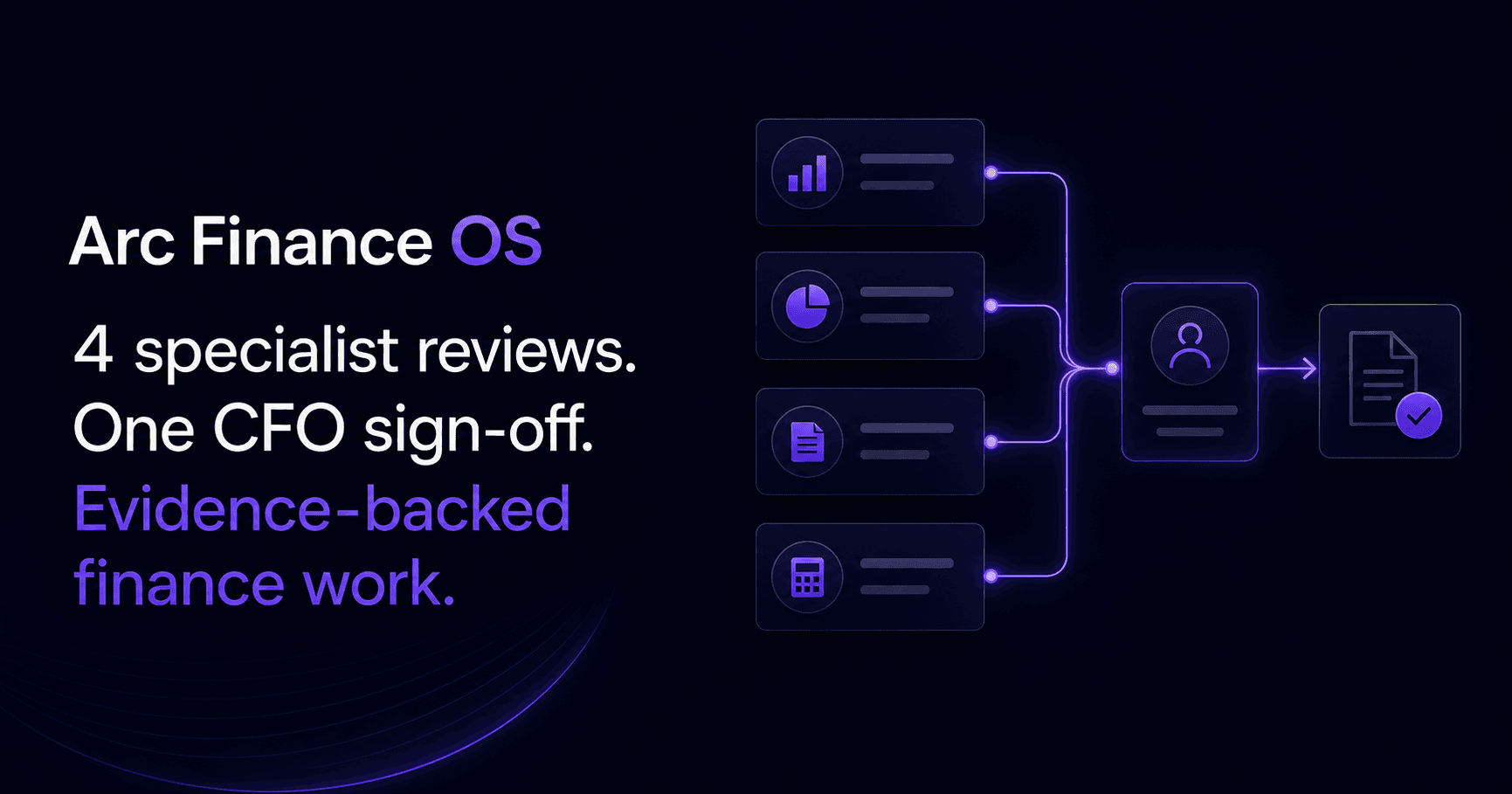
Product key visual. Four specialist cards feed the CFO, who challenges and synthesizes the single approved report on the right.
How It Is Built
How It Is Built
AI Orchestration
OpenAI Responses API · four parallel specialists + CFO synthesis
Transport
Axios · server-only OpenAI calls
Structured Output
Strict JSON Schema + local report-shape validation
Streaming
NDJSON from a Next.js App Router route
App
Next.js 16, React 19, TypeScript
Interface
GSAP motion, Tailwind CSS 4, restyled shadcn, Lucide
File Handling
OpenAI Files, temporary upload, deleted after each run
Infrastructure
Vercel serverless, Node.js 22
What I Built
What I Built
The orchestration, the streaming layer, the prompts and quality gates, the report contract, and the product interface, all built and deployed by me.
Orchestrated four specialist reviews as parallel OpenAI Responses calls, each streaming its own progress event, so the workroom shows real API state instead of a loading animation
Made the run fail safely by design: fewer than three specialist memos, or a CFO response that breaks the schema, and no report is presented as complete
Put the CFO on a separate, higher-reasoning model call that challenges the specialists and reconciles their conflicts before writing anything
Enforced the report contract twice, with OpenAI structured-output validation plus a local shape check, so a malformed report never reaches the screen
Treated every uploaded file as untrusted data and wrote prompts that forbid invented actuals, budgets, dates, and sources, keeping facts separate from assumptions
Streamed the whole run as NDJSON from a single Next.js route so the browser renders progress line by line as events arrive
Handled files responsibly: temporary upload to OpenAI Files, store:false on requests, a hashed safety identifier, and deletion in a finally step after success or failure
Built the full product surface, from command-center intake and the live workroom to the tabbed report viewer, session report library, and Markdown download, deployed on Vercel
Four specialist reviews, one CFO challenge, and a report that separates what the evidence supports from what it does not. An AI finance team that shows its work.
Access
See it run on a real brief.
The interesting part of Arc Finance OS is not the interface — it is watching four specialists work a leadership brief in parallel, the CFO challenge their memos, and the report name what the evidence does not support. Tell me what you want to see: a live walkthrough, a report from a real run, or a look at the source.